 Fraunhofer Institute for Software and Systems Engineering
In the BoostEDIC M&L project, we are supporting the establishment of a common European data infrastructure for the mobility and logistics sector. The aim of the four-year project is to further develop the European Mobility Data Space (EMDS) and establish a European Digital Infrastructure Consortium (EDIC). We are developing a knowledge hub as a central knowledge platform and drawing up recommendations for interoperable data spaces that enable cross-border data exchange throughout Europe.
BoostEDIC M&L
Further development of the European Mobility Data Space (EMDS) and establishment of a European Digital Infrastructure Consortium (EDIC)

The challenge
The European mobility and logistics sector faces considerable challenges in cross-border data exchange. Existing data infrastructures are fragmented, standards vary between countries and sectors, and there is a lack of uniform mechanisms for secure and efficient data sharing. These silo structures hinder innovative mobility services, multimodal transport solutions, and sustainable logistics chains. In addition, heterogeneous legal frameworks and technical incompatibilities make cooperation between public and private actors difficult. Without a coordinated European solution, significant potential for more efficient, safer, and more sustainable transport remains untapped.
Our contribution
As part of BoostEDIC M&L, we are developing the Knowledge Hub, a central knowledge platform for the European mobility data space. The hub provides access to information about available infrastructures, tools, standards, and best practices for interoperable data exchange. We are also conducting a comprehensive gap analysis of existing data platforms and developing concrete recommendations for improving technical interoperability. In doing so, we are contributing our expertise in the field of data ecosystems and data spaces.
The results
The project delivers a fully functional Knowledge Hub as an open-access resource, a coordination roadmap for harmonizing European initiatives, and a portfolio of cross-border use cases. Our technical recommendations address identified infrastructure gaps and propose concrete measures for the operation and maintenance of central data infrastructure components. The results form the basis for the future EDIC for mobility and logistics and promote the sustainable digitalization of the European transport sector.
Partners
- Stichting Connekt (coordinator)
- German Academy of Science and Engineering (acatech)
- Austriatech – Federal Association for Technology Policy Measures
- Federal Ministry of Transport (BMV)
- Circle Spa
- EIT Urban Mobility Foundation (EITUMF)
- EONA-X
- European Road Transport Telematics Implementation Coordination Organisation – Intelligent Transport Systems & Services Europe (ERTICO)
- Fintraffic Meriliikenteenohjaus OY
- Priemyselny Inovacny Klaster (IIC SK)
- Interuniversity Micro-Electronica Center (IMEC)
- Inlecom Group
- Luxembourg Institute of Science and Technology (LIST)
- Mobility as a Service Alliance (MAAS Alliance)
- Ministry of Infrastructure and Water Management (MIN I&W)
- Ministry of Transport and Sustainable Mobility (MITMS)
- Netherlands Organization for Applied Scientific Research (TNO)
- Trafikverket (TRV)
- Teknologian Tutkimuskeskus VTT OY (VTT)
Funding
- European Union, represented by the European Commission
- Funding code: 101195404
- Duration: 01/2026-12/2029

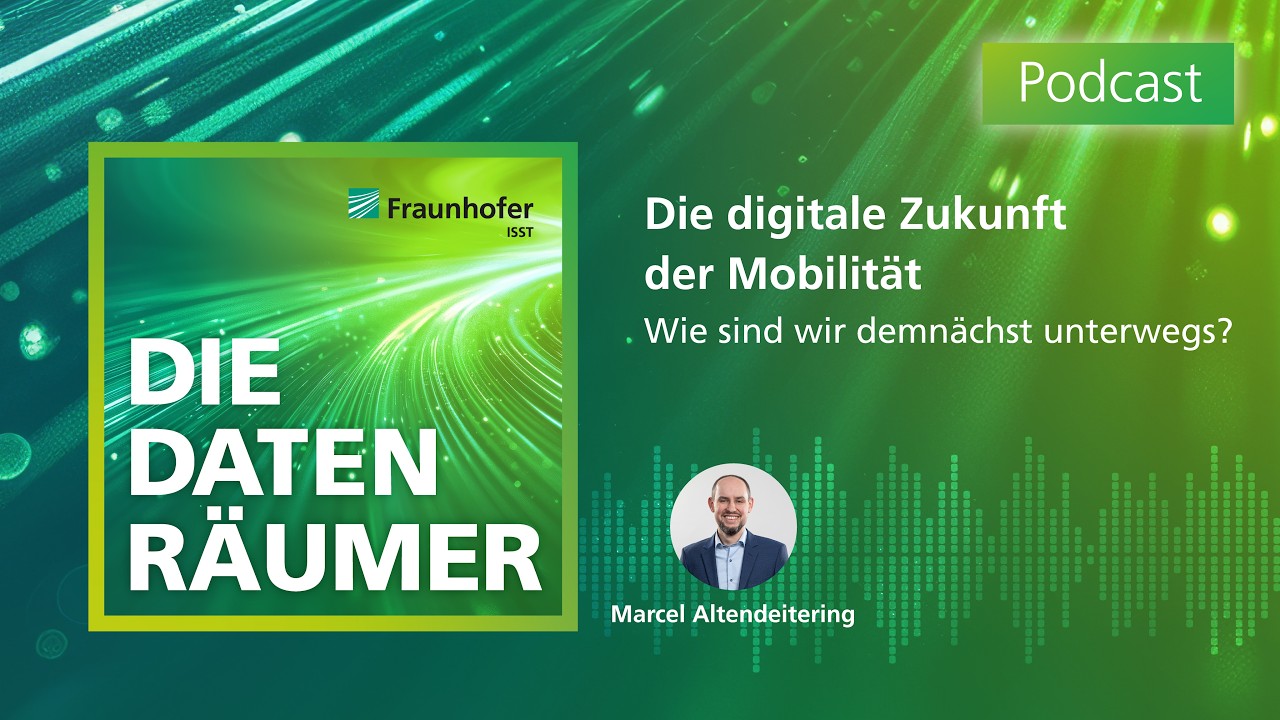
Podcast Episode: The Digital Future of Mobility [German]
How are we travelling in the future?
Privacy warning
With the click on the play button an external video from www.youtube.com is loaded and started. Your data is possible transferred and stored to third party. Do not start the video if you disagree. Find more about the youtube privacy statement under the following link: https://policies.google.com/privacyTrain tickets end at the state border, and the bus route doesn’t go all the way to the neighboring county: Anyone traveling by public transportation today has to fill in many gaps in the transit system on their own. But that could change if data could be shared among the various stakeholders in the mobility sector and used interoperably across different systems.