 Fraunhofer Institute for Software and Systems Engineering
The MECC@Solingen project is developing a modular digital twin for data-driven urban development. Building on preliminary work and the existing infrastructure of the city of Solingen, data sources, sensors, and systems are being interconnected. This creates an open, scalable data infrastructure that supports administration, planning, and operations and enables the flexible integration of future smart city applications. The focus is on the areas of municipal depots, urban intersections, and smart structural inspections.
MECC@Solingen - Mobility Edge-Cloud-Continuum in Solingen

The Challenge
Many cities and municipalities already have digital systems featuring LiDAR sensors, parking guidance systems, and multifunctional light poles. However, many data sources and infrastructure components still operate largely in isolation. As a result, connections between traffic, the environment, municipal depots, and infrastructure remain difficult to identify, and planning scenarios can hardly be tested virtually. This makes it particularly challenging to efficiently prioritize measures, personnel, and budgets, especially in the context of aging infrastructure. At the same time, requirements are increasing in terms of data quality, interoperability, data protection, cybersecurity, and the structured provision of mobility data—for example, via the Mobilithek.
Our Services
Fraunhofer ISST is responsible for the conceptual design and technical implementation of the modular Digital Twin. Together with the City of Solingen, the team identifies requirements, analyzes suitable use cases, and determines when a digital representation is sufficient and when a true Digital Twin is necessary. Building on this, Fraunhofer ISST is developing a reference architecture based on open standards and interfaces. The focus is on data integration, interoperability, and an architecture that gradually connects existing datasets, sensors, and systems. In addition, it implements the digital twin for selected use cases and creates a guide for municipalities.
The Result
The result is a transferable blueprint for municipal digital twins in medium-sized cities. Solingen is receiving a modular data infrastructure that makes real-time data from intersections, the municipal depot, infrastructure monitoring, and other municipal systems usable. It supports data-driven decision-making, creates transparency across administrative departments, and can be expanded in the future to include applications such as environmental monitoring, flood protection, or energy management. A guide documents best practices for other municipalities.
The Partners
- Fraunhofer ISST
- Fraunhofer IVI
- Fraunhofer IIS/EAS
- Solingen Public Utilities
- City of Solingen
Funding
Funding Body: Fraunhofer Cluster of Excellence Cognitive Internet Technologies CCIT
Duration: May 2026–December 2026
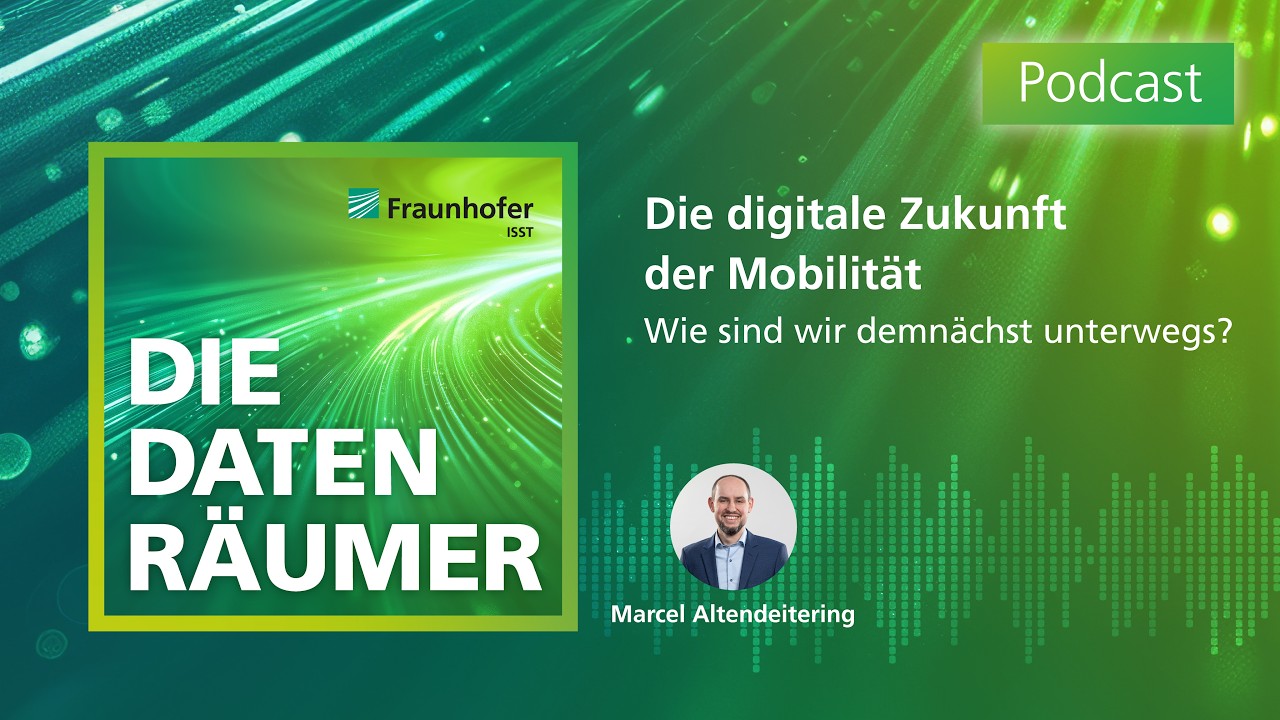
Podcast Episode: The Digital Future of Mobility [German]
How are we travelling in the future?
Privacy warning
With the click on the play button an external video from www.youtube.com is loaded and started. Your data is possible transferred and stored to third party. Do not start the video if you disagree. Find more about the youtube privacy statement under the following link: https://policies.google.com/privacyTrain tickets end at the state border, and the bus route doesn’t go all the way to the neighboring county: Anyone traveling by public transportation today has to fill in many gaps in the transit system on their own. But that could change if data could be shared among the various stakeholders in the mobility sector and used interoperably across different systems.